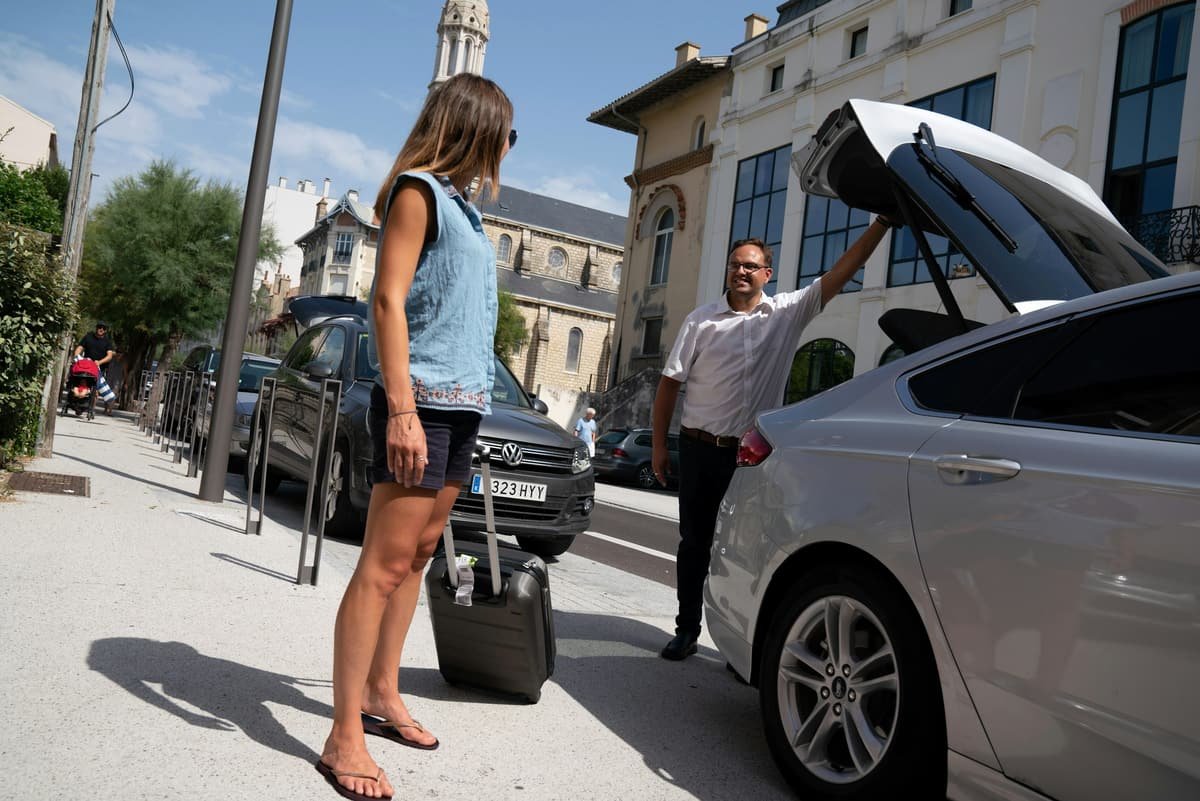
A ski bag, a golf bag, a dismantled bicycle, a double bass, a wheelchair: none of these fits a standard category, either on the aircraft or in the boot waiting outside. They have one thing in common: they have to be declared. Almost every problem with this kind of luggage comes from an omission at the time of booking, not from a refusal on principle.
Two checks, in this order
The first concerns the airline. Special equipment has its own carriage rules and its own pricing, and the number carried on any one flight is often capped — an aircraft does not take ten bicycles because ten passengers turned up with one. Hence the frequent requirement to declare in advance, sometimes with a deadline.
The second concerns the transfer. It is simpler but just as decisive: a boot has a length, a height and an opening. A ski bag does not fold. A cello case cannot be laid down any which way. A bicycle in a hard case takes the volume of a large suitcase, but without the give that lets one be wedged between two others.
Skis and snowboards
Most carriers define winter sports equipment as one set, not as separate items. At KLM that means one pair of skis with poles and boots, or one board with its boots, within 300 cm of combined dimensions — length plus width plus height — and 23 kg in economy, 32 kg in business class. At Transavia the set covers skis, boots, poles and helmet, or the snowboard with boots and helmet, for 15 kg maximum and a supplement of €50 per one-way journey; a sledge is accepted within 120 x 50 x 40 cm.
These rules vary from one airline to another and change over time: the principle to remember is that there is almost always a weight ceiling and an exhaustive list of what the set may contain. Ski boots packed separately count as an extra item.
Golf, bicycles
The golf bag is the simplest: it is treated as checked baggage, with a weight ceiling — 23 kg in economy and premium at KLM, 32 kg in business — and contents limited to clubs, balls and shoes. Depending on the type of ticket, advance booking is required.
The bicycle is the most demanding. It has to travel in a bag or case made for the purpose, handlebars aligned with the frame, pedals removed, tyres deflated. KLM requires booking at least 48 hours before departure. The point not to miss concerns electric bikes: the battery is banned from the cabin and from the hold alike. It does not travel with the bike, and no exemption is obtained at check-in.
Musical instruments
Three regimes exist side by side, and the choice is made when the ticket is booked.
- In the cabin, for compact instruments: at KLM, up to 55 x 35 x 25 cm and 12 kg in economy and premium, 18 kg in business class, with no additional hand luggage.
- On a purchased seat, for instruments that cannot go in the hold: up to 45 kg and 140 cm in height, reduced to 122 cm on European Embraer aircraft, with cellos treated separately.
- In the hold, in a hard case. Booking is required beyond 32 kg or 300 cm of combined dimensions.
An instrument travelling on a purchased seat also changes the transfer equation: it takes a seat on the aircraft, and it will take a real seat in the car.
Wheelchairs and mobility equipment
This case is governed by protective European law. A disabled person or a person with reduced mobility is entitled to free carriage of their mobility equipment, up to two items per person, including an electric wheelchair, subject to at least 48 hours’ notice before the departure time and to space constraints on board. Assistance at the airport is free as well, and is requested from the airline or the agency when booking, with the same notice. Where this is not respected, a report may be made to the Direction générale de l’aviation civile, the French civil aviation authority.
On the transfer side the question is not the principle but the mechanics: a manual folding chair loads into the boot of a Sedan, a non-folding electric chair needs an adapted vehicle and very early notice.
What to take away. Declare the nature of the items, not only how many. “Four bags” says nothing. “Two hold suitcases, two ski bags and one boot bag” allows the right vehicle to be chosen first time.
Which range to choose
Novalia offers four ranges, whose stated capacities are deliberately conservative: Economy and Sedan, up to 3 passengers and 3 bags; First Class Van, up to 6 passengers and 6 bags; Standard Van, up to 8 passengers and 8 bags. These figures apply to standard suitcases. An oversized item does not replace one of them: it is added to them, in volume as in length.
| What you are carrying | What to declare | Range to aim for |
|---|---|---|
| Skis or snowboard | Number of bags, boots packed separately or not | Van from two bags upwards |
| Golf bag | Number of bags, soft bag or hard case | Sedan for one bag, van beyond that |
| Bicycle | Soft bag or hard case, bike dismantled or not | Standard Van |
| Large instrument | Type of case, whether it must travel flat | First Class Van |
| Wheelchair | Folding or not, manual or electric | Depends on the chair and the number of passengers |
Loading, in practice
A few loading rules apply to every vehicle. Long items go along the axis of the car, never across the seat: heavy braking turns a badly wedged ski bag into a projectile. Hard cases lie flat, underneath, soft bags on top. A bicycle in a hard case takes up the whole floor of the boot and means folding a row of seats, so losing seats — that is precisely the calculation to make before booking, not on arrival.
Finally, a useful reminder about the luggage itself: in international air transport, the carrier’s liability for loss or damage is capped at around €1,300, and the claim has to be made in writing within seven days of damage being noticed, or within twenty-one days of a delayed bag being made available. For valuable equipment, specific insurance or a special declaration of interest in delivery is worth considering.
To declare oversized luggage and have the right range confirmed before booking: contact@novaliafleet.com.
Sources
Every figure in this article comes from one of these sources, consulted on 18 September 2026. Dates and fares published by third parties may change without notice.
- KLM — requirements for special baggage
- Transavia — winter sports equipment
- Transavia — special baggage
- Air France — special and oversized baggage
- Ministère de la Transition écologique — rights of disabled passengers and passengers with reduced mobility
- EUR-Lex — Regulation (EC) No 1107/2006
- European Commission — Your Europe, air passenger rights