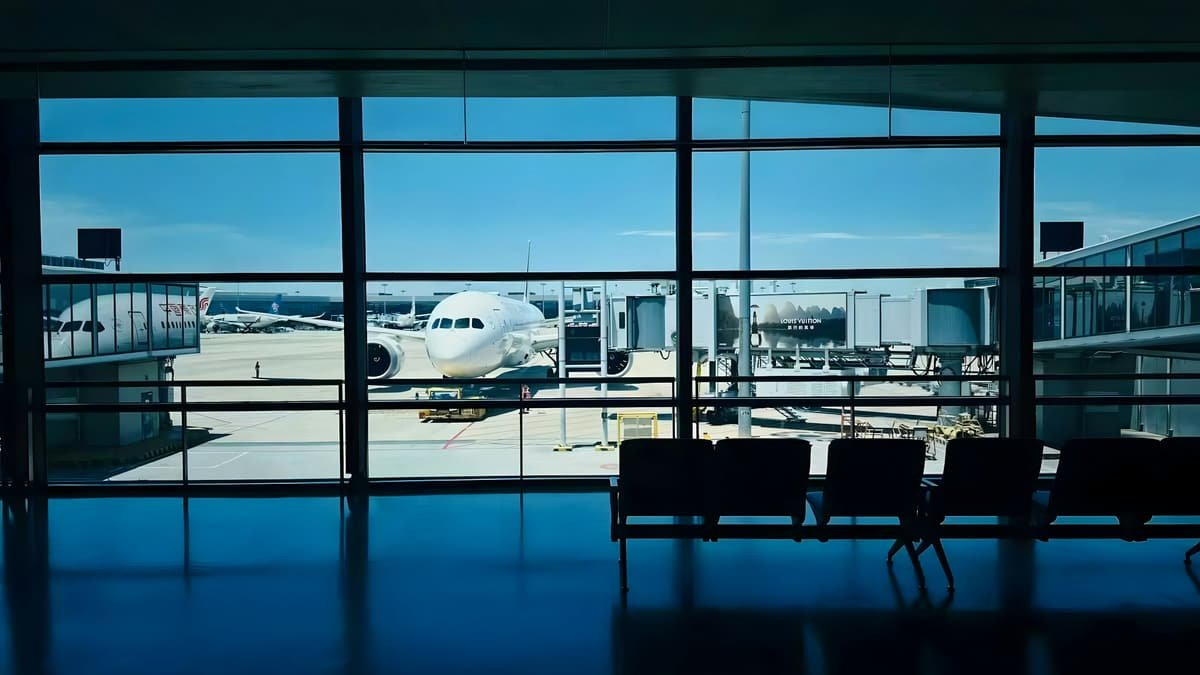
Marseille Provence airport lies in the commune of Marignane, about 27 kilometres north-west of Marseille, on the shore of the Étang de Berre. That position explains most of the logic of leaving it: the airport is not in the city it serves, and the Provence it opens up — Aix, the coast, the Var, the Luberon — is reached by roads that diverge the moment you leave the car park.
Terminal 1, terminal 2: two airports in one
The site reads as two distinct blocks, and that is the point travellers often discover too late.
Terminal 1 is the main building. It has been thoroughly reworked: the new terminal 1 opened on 17 June 2024, with about 22,000 m² of new build and 28,000 m² of refurbished space, halls A and B included. This is where the scheduled flights, the traditional airlines and most of the services are concentrated.
Terminal 2 is the former MP2 building, opened in September 2006 for the low-cost airlines. Its deliberately plain architecture follows a different logic: less retail space, more direct routes, and a layout sized for quick turnarounds. Ryanair has a base there.
Check before you go. Terminal 1 and terminal 2 are two separate buildings. A flight confirmation showing “T2” does not mean a hall in the main terminal but a different building, with its own drop-off and its own access roads. It is the most expensive mistake to make at Marignane.
What changes with a low-cost flight
Arriving at terminal 2 does not make leaving harder, but it moves it. There are three practical differences.
- The drop-off and pick-up point. Terminal 2 has its own access roads. Simply saying “Marseille airport” to a driver who does not know the site can land you at the wrong building; the terminal number is as much a part of the information to pass on as the flight number.
- The services available. The shops and catering are noticeably more limited than at terminal 1. That weighs most on late arrivals and on waiting when a flight is delayed.
- The volume of luggage. Low-cost flights concentrate paid hold bags and oversized cabin bags. The number of cases actually loaded determines the vehicle category far more reliably than the number of passengers.
Leaving: shuttles, coaches, TER trains
The airport’s coach station offers an unusually wide range of services for a regional airport. The destinations go well beyond Marseille: Aix-en-Provence, Salon-de-Provence, Martigues, Toulon, the Manosque – Forcalquier – Digne – Sisteron – Gap corridor, the Fréjus – Cannes – Antibes – Nice corridor, the Nîmes – Montpellier – Béziers – Narbonne – Toulouse – Bordeaux corridor, and the seasonal Navettes Blanches to the ski resorts of the southern Alps.
The airport also has an indirect rail link. The TER station Vitrolles-Aéroport-Marseille-Provence reaches some thirty towns in the region — Marseille, Arles, Avignon, Nîmes, Montpellier — with up to 73 trains a day. It is reached from stand no. 5 of the coach station by the Bus+13 shuttle, which runs every 12 minutes for a journey of about 5 minutes, at a fare of 1,20 euro. The shuttle runs seven days a week, Sundays and public holidays included.
Getting to Marseille
The main link to the centre is the A1 shuttle, which connects the airport to Marseille Saint-Charles station by motorway. The operator quotes a journey time of roughly 30 to 50 minutes in normal traffic, with a departure every 10 minutes from 7am to 8pm and an extended service early in the morning and late in the evening. The airport’s help centre puts Marseille Saint-Charles 30 minutes away by this shuttle.
That range of 30 to 50 minutes is worth pausing on. It does not reflect vagueness but a reality: entering Marseille from the north, via the A7 and the tunnel, is a structural bottleneck at peak times. The same journey can therefore take twice as long depending on when you land. The rail alternative exists: the Bus+13 shuttle to Vitrolles, then the TER to Saint-Charles, which Marseille’s tourist office puts at about twenty minutes. It means a change and carrying your luggage, but it escapes the road traffic.
For an arrival with luggage, with family, or to an address that is not right next to Saint-Charles — Les Goudes, Le Roucas Blanc, the Marseille calanques — going direct by road is still the shortest door to door, since it removes the change at the station.
Aix-en-Provence
Aix is closer to the airport than Marseille. The Aix-en-Provence tourist office puts the airport 25 kilometres from the city centre, a journey of about 25 minutes, and the Aix-en-Provence TGV station 15 kilometres from the centre. The A2 line links the airport to Aix-Centre in about 30 minutes in normal traffic, every 25 to 30 minutes, from about 4.50am to a little after midnight, with stops on request for the Pôle d’activités and Plan d’Aillane. The airport’s help centre also puts Aix-en-Provence TGV station 15 minutes away by shuttle.
It is a geography that often surprises: for a stay in inland Provence, landing at Marseille and sleeping in Aix is quicker than reaching the Vieux-Port.
Cassis, the calanques and the Var
Cassis is 55 kilometres from the airport, on the far side of Marseille. The Cassis tourist office gives the road benchmarks: 30 minutes from Marseille on the A50, 45 minutes from Aix-en-Provence via the A8, the A52 and the A50, 50 minutes from Toulon on the A50. You therefore have to add crossing the Marseille conurbation to the coastal drive — which makes the door-to-door time noticeably longer than the distance suggests.
One regulatory point is worth planning for if the trip is aimed at the calanques. From 1 June to 30 September, the préfecture assesses the fire risk each day between 5pm and 6pm, massif by massif, for the following day. Three massifs concern Cassis directly: the Calanques, Cap Canaille and Grand Caunet. On days rated red, access to the national park on foot is banned and the Route des Crêtes is closed; boats may still sail but landing is strictly forbidden. The decision can be checked the evening before on the dedicated page of the préfecture’s website or through the Mes Calanques app. A transfer planned to the start of a walk may therefore have to be redirected the evening before.
Towards the Var, the route follows the A50 through Aubagne and the coast, then the A57 beyond Toulon. One coach line runs direct from the airport to Toulon coach station, and another serves the Fréjus – Cannes – Antibes – Nice corridor. For a precise destination in the Var — a village on the gulf, a peninsula, a mas off the beaten track — public transport stops at the coach stations, and the last few kilometres remain to be covered.
In practice
Four pieces of information are enough to organise an arrival at Marignane: the flight number and its time, the terminal — 1 or 2, the exact destination address, and the number of bags. The terminal matters more here than at most French airports, since it determines the building the vehicle pulls up outside.
At Novalia, the journey is confirmed in advance, the flight is tracked so the pick-up can be adjusted if it is delayed, and the price is fixed and known before payment. To arrange an arrival at Marseille Provence, a transfer to Aix, Cassis or the Var, or a return at the end of a stay: contact@novaliafleet.com.
Sources
Every figure in this article comes from one of these sources, consulted on 18 September 2026. Dates and fares published by third parties may change without notice.
- Marseille Provence Airport — Shuttle to Marseille Saint-Charles station
- Marseille Provence Airport — Buses to Aix-en-Provence
- Marseille Provence Airport — Buses and shuttles
- Marseille Provence Airport — Trains
- Marseille Provence Airport help centre — The nearest stations
- Marseille tourist office — Getting to Marseille
- Aix-en-Provence tourist office — Access and transport
- Cassis Tourisme — Getting to Cassis
- Calanques National Park — Fire risk and access
- Wikipedia — Marseille Provence Airport