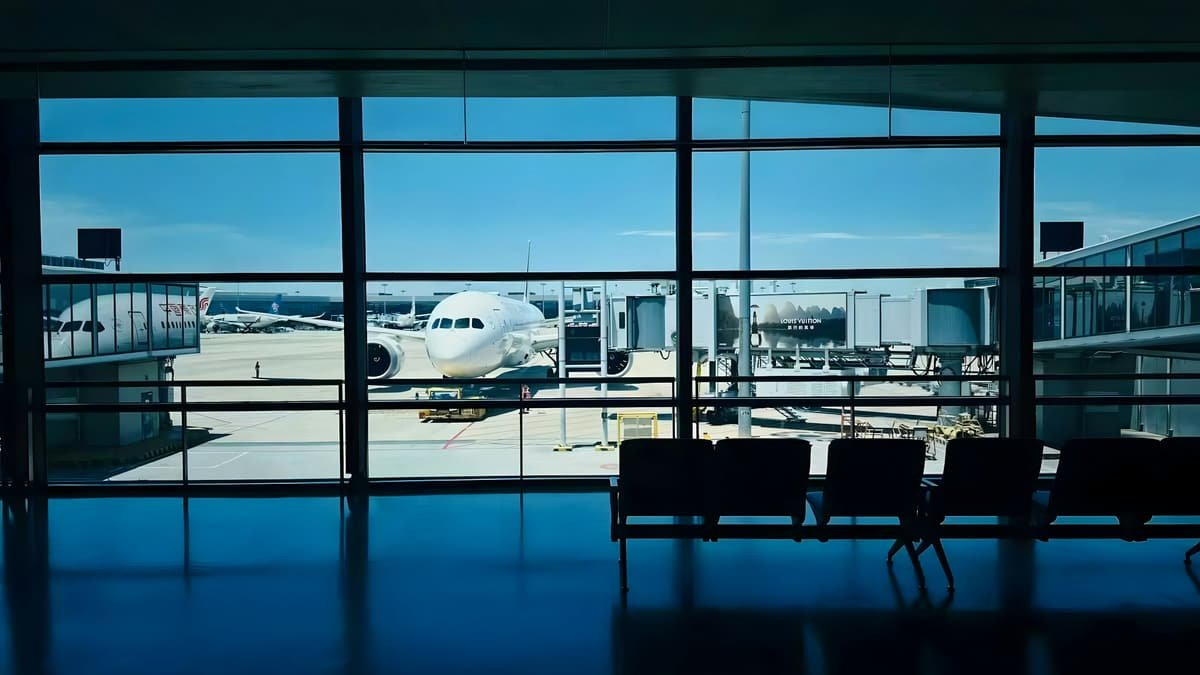
Paris-Charles de Gaulle handled 72,0 million passengers in 2025, up 2,5 %. It is France’s largest airport, and the one whose internal geography confuses people most: we speak of three terminals, but there are in fact nine separate buildings. Knowing which one concerns you before you land settles most of the difficulty of getting out.
Three terminals, nine buildings
Terminal 1 is the original circular building, the one nicknamed the camembert: a 195,000 m² central core ringed by seven boarding satellites. Reopened on 3 December 2022 after a redesign of the passenger route, it is sized for 10,2 million passengers a year.
Terminal 2 is not a building but a series of halls lettered 2A to 2G. Halls 2A and 2C were joined by a link building in April 2012, halls 2B and 2D by a 23,500 m² connecting building. Halls 2E and 2F occupy the eastern part, with 2E extended by satellites S3 and S4. Hall 2G stands apart: an isolated building served by a road shuttle, often confused with the rest of terminal 2.
Terminal 3, the former T9, opened in 1991, is a low building with no air bridges: you reach the aircraft by bus. It handles charter and low-cost flights.
What to remember. Two flights with the same airline, at the same time, can arrive in two buildings several kilometres apart. The flight number is the only piece of information that determines the hall.
What changes in March 2027
On 8 December 2025, Groupe ADP announced that the current naming would be dropped. From March 2027, the terminals will be numbered 1 to 7, in the order passengers pass through them. Terminal 1 is the only one to keep its name. Terminal 3 becomes terminal 2; the 2A-2C pair becomes terminal 3; the 2B-2D pair becomes terminal 4; 2E becomes terminal 5; 2F becomes terminal 6; 2G becomes terminal 7.
The principle: figures outside, letters inside for the departure lounges. The signage is being replaced — more than 3,000 signs in the terminals, 600 in the car parks, 250 road items — between September and December 2026, that is to say now, and some airlines adopted the new naming as early as March 2026. The consequence: a flight confirmation, a road sign and an app may not say the same thing. It is safer to give both names until the changeover is complete.
Moving between the terminals
The CDGVAL is the automatic metro that links the terminals to each other. It is free, runs every day from 4am to 1am, and serves five stations: Terminal 1, Parc PR, Terminal 3–Roissypôle, Parc PX and Terminal 2–Gare. The full run takes about eight minutes. A second line, LISA, serves the satellites of hall 2E airside.
Two stations serve the airport on the RER B: Aéroport Charles de Gaulle 1, at Roissypôle, next to terminal 3, which serves terminal 1 via the CDGVAL; and Aéroport Charles de Gaulle 2 TGV, in the heart of terminal 2, between halls 2C, 2D, 2E and 2F. Trains run every 6 to 15 minutes, from 4.50am to around midnight.
Between landing and leaving
No operator publishes a guaranteed time between touchdown and the arrivals doors: that time is the sum of four independent variables. Taxiing, which can exceed a quarter of an hour on the remote stands. The walk, which varies enormously by hall — leaving a terminal 1 satellite or hall 2G has nothing in common with leaving 2A. Border control. And finally baggage reclaim, the least predictable of the four.
The European entry-exit system, the EES, now weighs on the third of those. Rolled out gradually since 12 October 2025, it has been fully in service since 10 April 2026. It applies to third-country nationals on short stays in the Schengen area and records, in addition to travel document data, biometric data: a facial photograph and fingerprints from the age of twelve. France has installed optional pre-registration kiosks at twenty-five major airports, ports and stations. The consequence is clear: setting the pick-up by the scheduled landing time makes no sense. What protects you is flight tracking and waiting time included in the service.
Touts, and what the law says
The areas around the arrivals halls are well known for travellers being approached. The legal framework, though, is unambiguous. Article L. 3120-2 of the code des transports prohibits a chauffeur-driven vehicle from stopping, parking or driving on a public road in search of customers; the breach is a fifth-class contravention under article R. 3124-11. And where the vehicle picks up a customer without a prior booking, article L. 3124-12 provides for one year’s imprisonment and a fine of 15,000 euros. In other words: a driver who approaches you in the hall is not operating lawfully. A booked chauffeur waits at an agreed point and has nothing to negotiate on the spot.
On the taxi side, the fares between Paris and its airports are regulated: the DGCCRF gives maximum amounts of 56 euros between Roissy and the Right Bank, 65 euros to the Left Bank. These are ceilings, and the meter must be switched on even if the price was agreed before the journey.
Where to find your chauffeur
The meeting point is set at booking, not on arrival. Three pieces of information are enough: the flight number, which determines the hall; the number of bags, which determines the vehicle; and the name the journey is booked under. Two arrangements exist side by side: a greeting in the arrivals hall, with the chauffeur waiting at the exit from the baggage belt holding a sign with the passenger’s name; or a pick-up at the short-stay drop-off, which is quicker when you travel light. In both cases, tell us about any change: a diverted flight or a hall changed the day before is easy to handle if it is flagged.
Paris, La Défense, Disneyland
For Paris, the RER B remains the reference rail link; the Paris Région ↔ Aéroports ticket costs 14 euros, 7 euros at the reduced rate. The RoissyBus, meanwhile, has been withdrawn: Île-de-France Mobilités stopped it for good on 1 March 2026, its ridership having fallen by nearly 40 % since 2023. It is replaced by express line 9517, which links Saint-Denis-Pleyel to the airport in 30 minutes. A dedicated link is expected: the CDG Express will connect Gare de l’Est to the airport non-stop in 20 minutes, with a train every 15 minutes from 5am to midnight. It opens on 28 March 2027.
For Paris La Défense, there is no direct airport link at all: the district is served by metro 1, the RER A and E and tram T2, which means at least one change. It is a maze of stacked roadways where a postal address is not enough to identify a drop-off point.
For Disneyland Paris, Marne-la-Vallée – Chessy station is 200 metres from the park and 25 kilometres from Paris. It is linked to Aéroport Charles-de-Gaulle 2 TGV station by a service quoted at 10 minutes — fast, but it assumes you landed on the right side of the airport and can live with limited frequencies. With children and suitcases, going direct by road is often simpler.
In practice
Gather four things before booking: the flight number and its arrival time, the terminal or hall shown on your confirmation, the exact destination address and the volume of luggage — that last point determines the vehicle category.
At Novalia, the journey is confirmed in advance, the flight is tracked so the pick-up can be adjusted if it is delayed, and the price is fixed and known before payment. To arrange an arrival at Roissy or a return trip: contact@novaliafleet.com.
Sources
Every figure in this article comes from one of these sources, consulted on 18 September 2026. Dates and fares published by third parties may change without notice.
- Groupe ADP — Reopening of terminal 1 at Paris-Charles de Gaulle
- Groupe ADP — Traffic for December and the full year 2025
- Le Journal de l’Aviation — New names for the Paris-CDG terminals in March 2027
- TourMaG — The terminals at Paris CDG airport will change name from 2027
- Île-de-France Mobilités — End of the RoissyBus
- Île-de-France Mobilités — Paris Région Aéroports ticket
- CDG Express — The project
- French Ministry of the Interior — All about the entry-exit system (EES)
- Sénat — Tougher penalties for illegal plying for hire by private hire vehicles
- DGCCRF — Taxis: understanding regulated fares
- SNCF Connect — Marne-la-Vallée – Chessy station
- Paris La Défense — Access and routes
- Wikipedia — CDGVAL
- Wikipedia — Paris-Charles-de-Gaulle Airport